Google·2021-2025·AI, Enterprise

Reimagining How Google Marketing Works

An AI-powered platform that unified fragmented marketing workflows into intelligent orchestration.

The story

Led the vision and experience design of an AI-powered platform that unified fragmented marketing workflows and helped teams move from manual coordination to intelligent orchestration.

My contributions
  • Led design end to end for Mandala, owning the interaction model, north-star vision, and cross-surface consistency.
  • Balanced long-term platform bets with the team's near-term roadmap so we shipped forward without losing the horizon.
  • Partnered with product, engineering, and research leaders across 6+ orgs to align on one orchestrated ecosystem.
  • Ran design jams and prototyping sprints that gave partner teams a shared language and unblocked hard decisions.
  • Presented to SVP-level leadership and turned two prototypes into a funded, staffed, multi-year program.
Role
Senior Interaction Designer
Client
Google
Year
2021-2025
Discipline
AI, Enterprise
Scope
  • Vision
  • Workflow design
  • AI orchestration
  • Cross-platform spec
+60%
Campaign speed
89%
User satisfaction
SVP greenlit
Executive support
Chapter 01

The problem

Google Marketing lived across hundreds of tools, dashboards, and spreadsheets. Planners spent more time coordinating than deciding. Every new product added another seam, and every campaign meant re-stitching context by hand. The real opportunity wasn't another marketing app, it was rethinking how marketing work itself moves through the org.

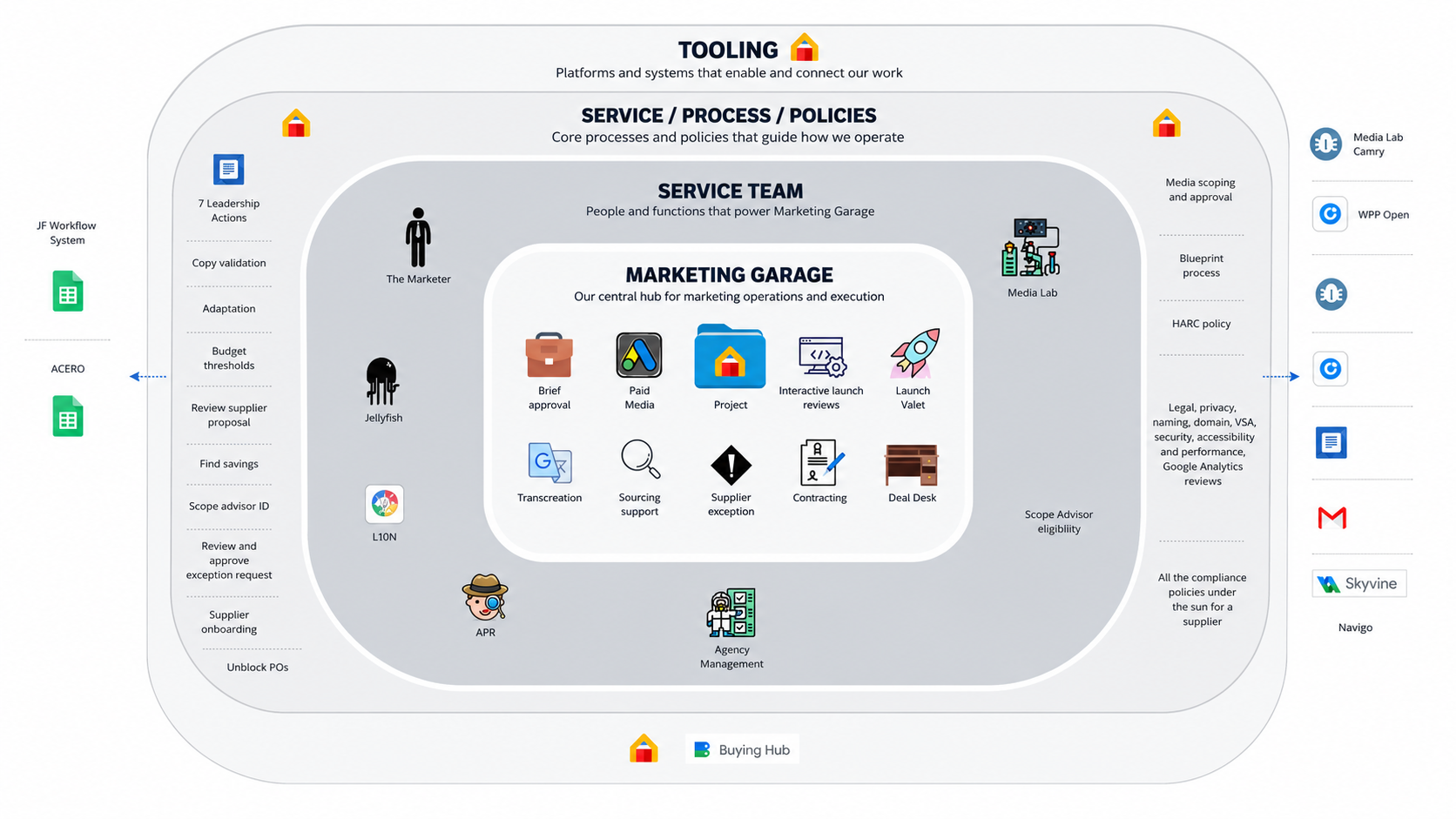
Diagram showing the Google Marketing Garage ecosystem with Service Team, Service/Process/Policies, and Tooling layers surrounding the central hub.
The ecosystem. Marketing Garage sits at the center of tools, teams, and policies that power Google's marketing operations.
Chapter 02

The insight

Most proposals on the table tried to optimize individual tools. I argued for the opposite. Stop optimizing the parts and start orchestrating the whole. That single reframe is what made Mandala possible, and what made leadership pay attention. AI wouldn't replace the marketer, it would carry the thread between tools so people could stay in the strategic work instead of the plumbing.

Chapter 03

Explorations and iterations

Before converging on Mandala, I led a body of exploratory work: heuristic evaluations of the tools teams used every day, archetype activities to ground the work in real roles, FigJam design jams across the org, and sketch-level explorations of what an AI-native workspace could feel like. Each artifact became a vehicle for discussion, helping product, engineering, and leadership see what was possible.

01 · Heuristic eval. Auditing existing Marketing Garage flows to find the seams worth redesigning.
02 · Design jams. Cross-functional FigJam sessions mapping pain points, ideas, and opportunities.
03 · Sketches. Rapid sketch explorations of layouts, patterns, and the shape of an AI-native workspace.
04 · Archetype activity. Grounding the work in real roles: an archetype activity to align on who we were designing for.
Chapter 04

Mandala, up close

Mandala is less a single product and more a connected set of surfaces. Each one shares the same orchestration model, so a decision in planning ripples into briefs, approvals, audiences, concepts, and assets, without losing context along the way.

Overview slide of the Mandala ecosystem showing how planning, audiences, creative, and assets connect through a single orchestration layer.
A workspace of capabilities, all connected. The full Mandala ecosystem: planning, audiences, creative, and assets, all flowing through a single orchestration layer.
01 · Plan the work. Intelligent workspace: adapts to the task, pulling in data, audiences, and collaborators as they're needed. The result: less setup, faster campaigns.
02 · Understand the audience. Actionable audience insights: AI correlates MAP, research, social, and Google signals into one clear picture that feeds every downstream decision.
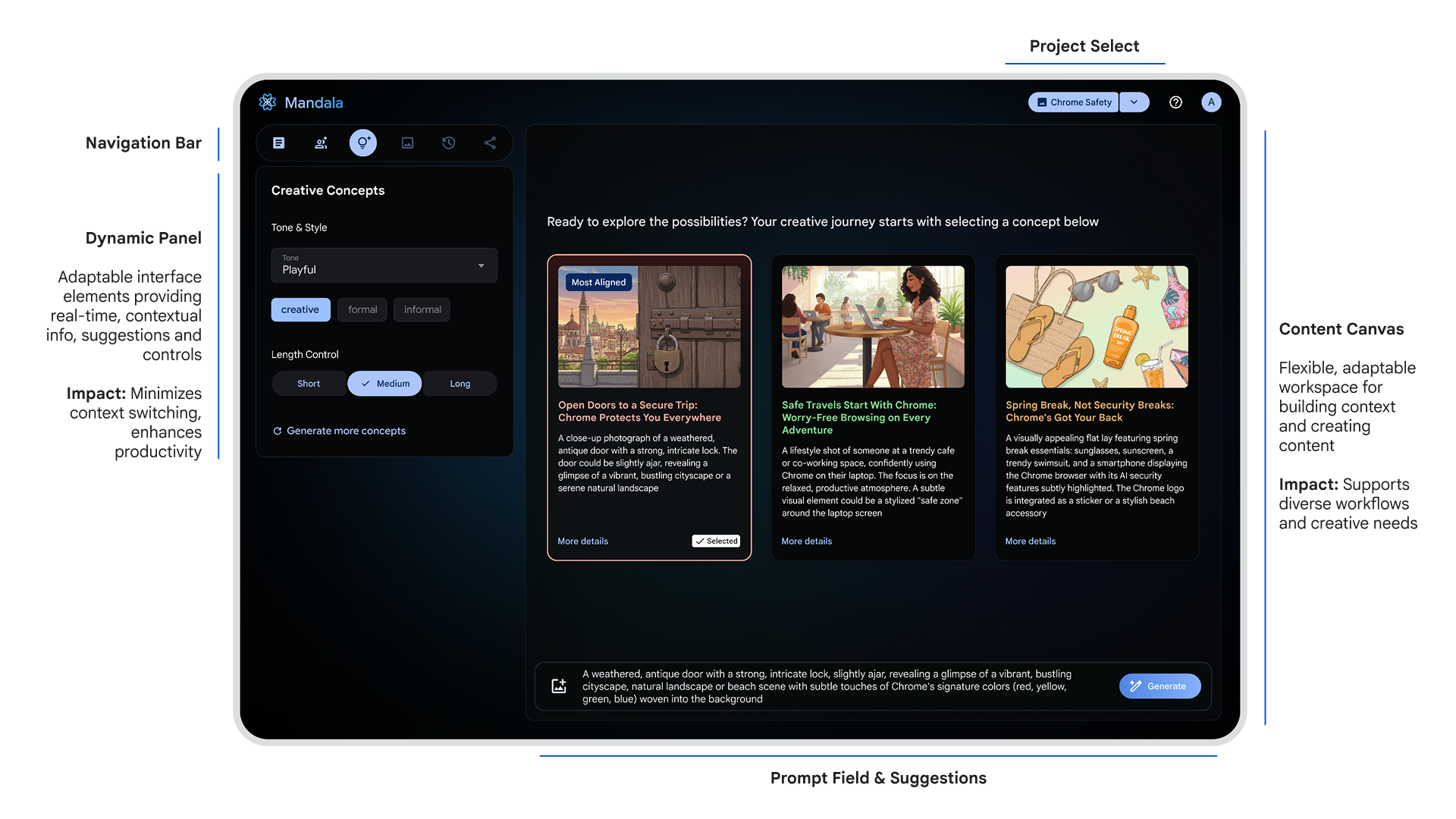
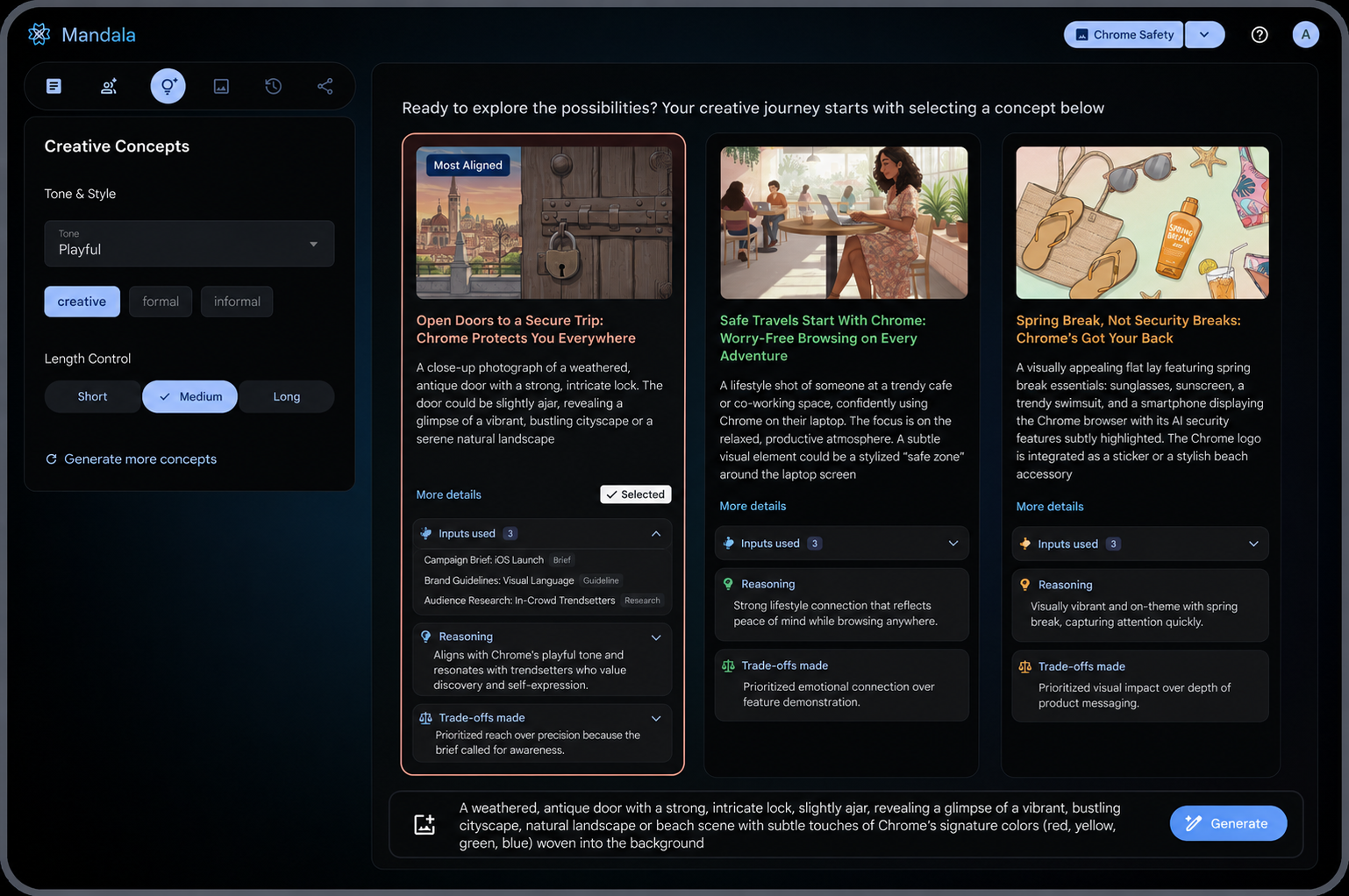
03 · Shape the creative. Intelligent concept generation: three distinct directions grounded in the brief and audience, so teams explore more high-quality ideas, faster.
04 · Ship the work. Contextual asset integration and editing: drag in brand-compliant assets and edit them inline. Less handoff, less rework, faster to launch.
Chapter 05

Beyond Mandala: AI across the marketing org

Mandala was the north-star, but it sat inside a broader body of work. I designed AI capabilities across Google's marketing ecosystem, from audience building to creative workflows to measurement. Each capability followed the same orchestration model: intelligence inside the work, grounded in the team's real material, so adopting one made the next feel familiar.

Theme · 01

Orchestration & planning

Marketing Garage: the connected workspace where briefs, plans, and approvals move together.

Marketing Garage workspace. The operating layer that ties briefs, plans, and recommendations into a single connected surface, so teams can move from intent to plan without losing context.
Plan-on-a-page handoff. A structured, AI-assisted handoff that turns scattered inputs into a shared plan, the connective tissue between strategy and activation.

Theme · 02

Audiences & insights

Intelligence for understanding who you're talking to, and how the work is landing in market.

AI Audiences. Describe the audience you want in plain language and the system assembles it from signals across the org, with reasoning, sources, and trade-offs exposed so marketers can shape and trust the result.
AI Insights map. A spatial view of audience and campaign signals that surfaces relationships across markets, segments, and behaviors, grounded in the team's real data.
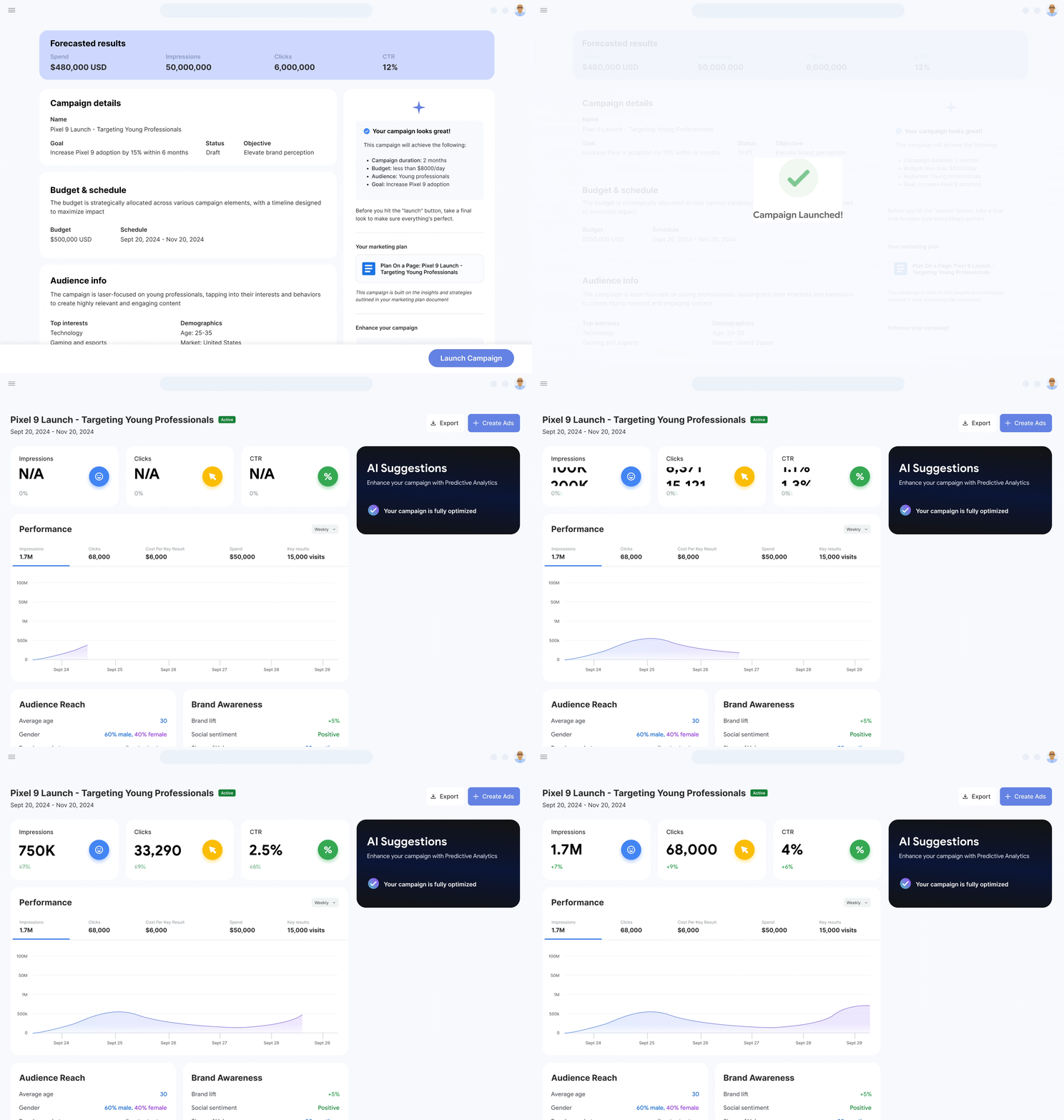
Animated prototype of real-time forecasted campaign results with inline AI guidance.
Real-time campaign insights. Forecasted results and AI-generated guidance shown alongside the campaign itself, so marketers can adjust before launch instead of after the fact.

Theme · 03

Creative & activation

AI that helps marketers move from idea to asset without leaving the work.

Asset Studio. A generative creative surface where teams can produce on-brand assets from a brief, with the brand model, audience, and channel constraints baked in from the start.

Theme · 04

Vision & north star

The longer-horizon concept work that set direction for where the ecosystem could go next.

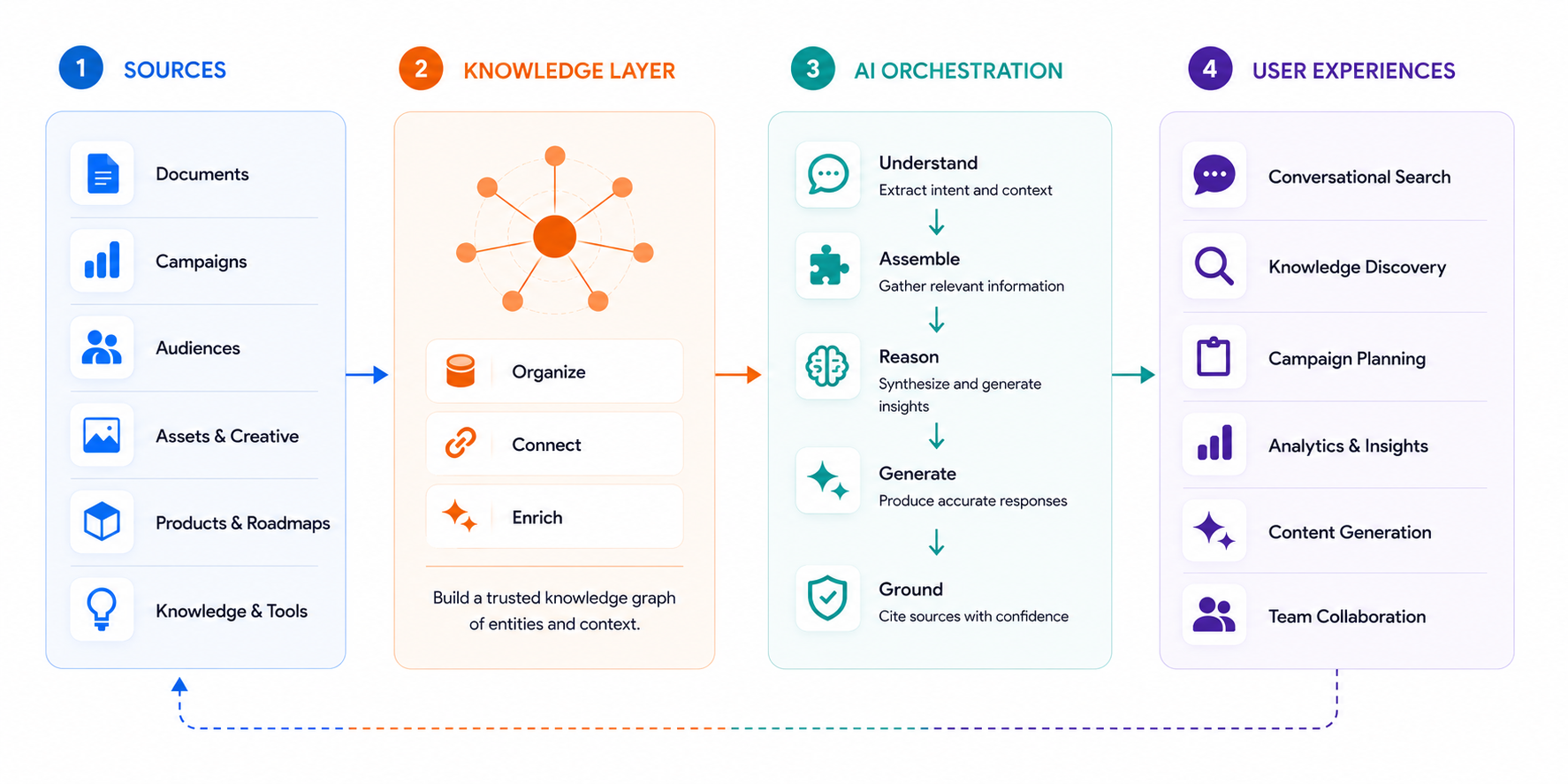
Ecosystem vision · I. A north-star concept showing how AI capabilities could compose into a single, intelligent surface for marketing work, used to align leadership on the destination.
Ecosystem vision · II. A companion vision exploring how intelligence flows between planning, audiences, creative, and measurement, so adopting one capability strengthens the others.
Chapter 06

Missteps that shaped what shipped

Mandala didn't arrive fully formed. Week one: we pitched full automation. Feed it a brief, get a finished plan back. The room went quiet. Nobody trusted a black box making decisions for them. By week four we scrapped the autopilot framing and rebuilt around a copilot model where every AI move is explainable, editable, and ignorable. We tried a unified inbox for cross-tool notifications. It tested as noise, not signal, and we cut it. Mid-project we realized the org didn't want another login. Reframing Mandala as orchestration, making the existing tools behave like one system, unlocked SVP support that had been stuck for months. Later versions added a brief quality score, richer visual guidance, and an agent experience with fewer clicks and clearer insights. The throughline: when AI hides its work, marketers stop using it. When it shows its work, they trust it with bigger decisions.

Prototype 01. An early copilot prototype used to pressure-test the orchestration model with marketing leads.
Prototype 02. A second concept exploring how briefs, audiences, and concepts stay connected across surfaces.
Prototype 03. A later prototype tightening explainability, brief quality signals, and agent-driven suggestions.
Chapter 07

Human-AI creativity principles

Beyond Mandala, the project produced a set of Human-AI creativity principles that other teams in the org continue to build against. The guiding philosophy: foster a collaborative partnership between marketers and GenAI, so AI amplifies expertise rather than replacing it. For AI to truly empower marketers, it must be a trusted partner, not a black box.

Chapter 08

Prototypes that moved the org

The vision earned SVP support the moment leaders could watch the work behave. Two high-fidelity Mandala prototypes, and the broader ecosystem work behind them, turned an abstract argument into something you could point at. Campaign speed climbed 60%, satisfaction moved from 34% to 89%, and leadership greenlit a dedicated team and multi-year budget to deliver the roadmap. More lasting than any single screen: a shared language, orchestration, not optimization, that reframed how the org thinks about marketing tooling.

Reflection

What I learned

AI has to disappear into workflows

The moment intelligence demands its own tab, it becomes another tool to manage. When it lives inside the brief, the plan, or the approval, it becomes a teammate. The real challenge in enterprise design is rarely a single screen. It's the invisible wiring between systems, incentives, and habits.

Prototypes move organizations, not decks

The vision earned SVP support the moment leaders could watch the work behave. High-fidelity prototypes turned an abstract argument into something you could point at, and leadership stopped debating the concept and started debating the details.

A shared language is the real deliverable

Orchestration, not optimization, gave eight teams the same frame. That frame outlasted any single screen and reshaped how the org thinks about tooling. The most durable design work isn't a single feature, it's a shared way of seeing the system that other teams can build from.

The most impactful prototypes help orgs imagine, not just validate

Design artifacts earn their keep when they help organizations see possibilities that previously felt impossible. That's when a prototype stops being a spec and becomes a north star the whole company can move toward.